The packaging industry is facing several simultaneous challenges: labor shortages for repetitive manual tasks, growing product variability, and increasingly demanding traceability requirements across the entire supply chain. These factors directly impact the overall capacity, stability, and efficiency of the line at the end of the production process, where products are grouped and prepared for dispatch.
The end of the line is not merely a point where products are grouped together. It is also one of the main constraints on a plant’s overall equipment effectiveness (OEE), especially in environments with high product variability.
This is precisely where an industrial case packer makes the difference. Automating secondary packaging can stabilize the production flow, reduce reliance on manual labor, and improve process consistency – provided the solution is correctly sized and integrated within the line’s overall system.
This guide explains what a case packer is, how it works in real production environments, the different types, and the criteria for selecting one.
What is a case packer, and what is it for?
A case packer, also known as a case packing machine, is the equipment responsible for the secondary packaging of products. It handles packaged items that arrive on a conveyor, groups them, and places them inside corrugated cardboard cases. The cases are then sealed for distribution.
The main objective is to replace or reduce manual intervention at this stage of the process as much as possible, which results in greater repeatability, lower operational variability, and an overall improvement in productivity and safety.
The basic case packing process generally comprises the following stages:
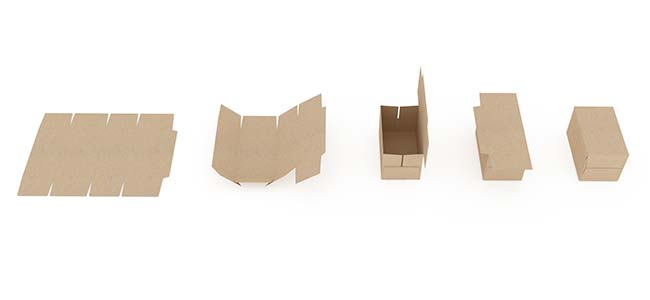
- Case erection: Converting flat corrugated blanks into formed cases, or using pre-formed cases.
- Product collation: Items are arranged and grouped according to the required packing pattern.
- Product loading: The product is placed inside the case by mechanical systems, pushers or robots.
- Closing and sealing: The flaps are folded and sealed with tape or hot melt.
- Transfer to palletizing: The closed cases are conveyed to the next process, usually palletizing.
Types of industrial case packer
There are different types of case packers, which vary depending on the product loading system and the case format. The right model depends on the product type, production volume, fragility of the packs, and the space available on the factory floor.
Top-load case packer
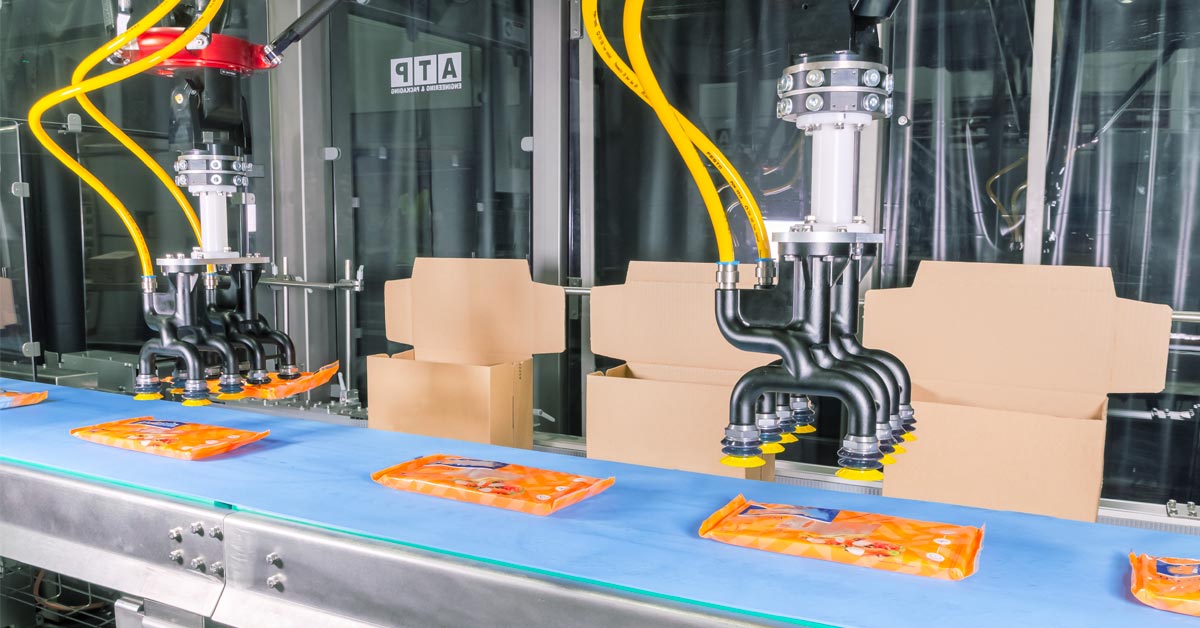
A top-load case packer introduces products from above into an open case throughout the packing process. This system is primarily used in applications where the product requires careful handling or a specific orientation before placement into secondary packaging.
It works with pre-formed cases, such as RSC formats, trays or Packmaster-style solutions, among others. This compatibility allows for a high degree of flexibility when integrating with different types of packaging without altering the product loading logic.
Products usually arrive pre-aligned or stabilized via conveying, separation or accumulation systems. In many cases, an upstream buffer ensures proper synchronization of the flow, avoiding fluctuations in the rate at which the product enters the packing system.
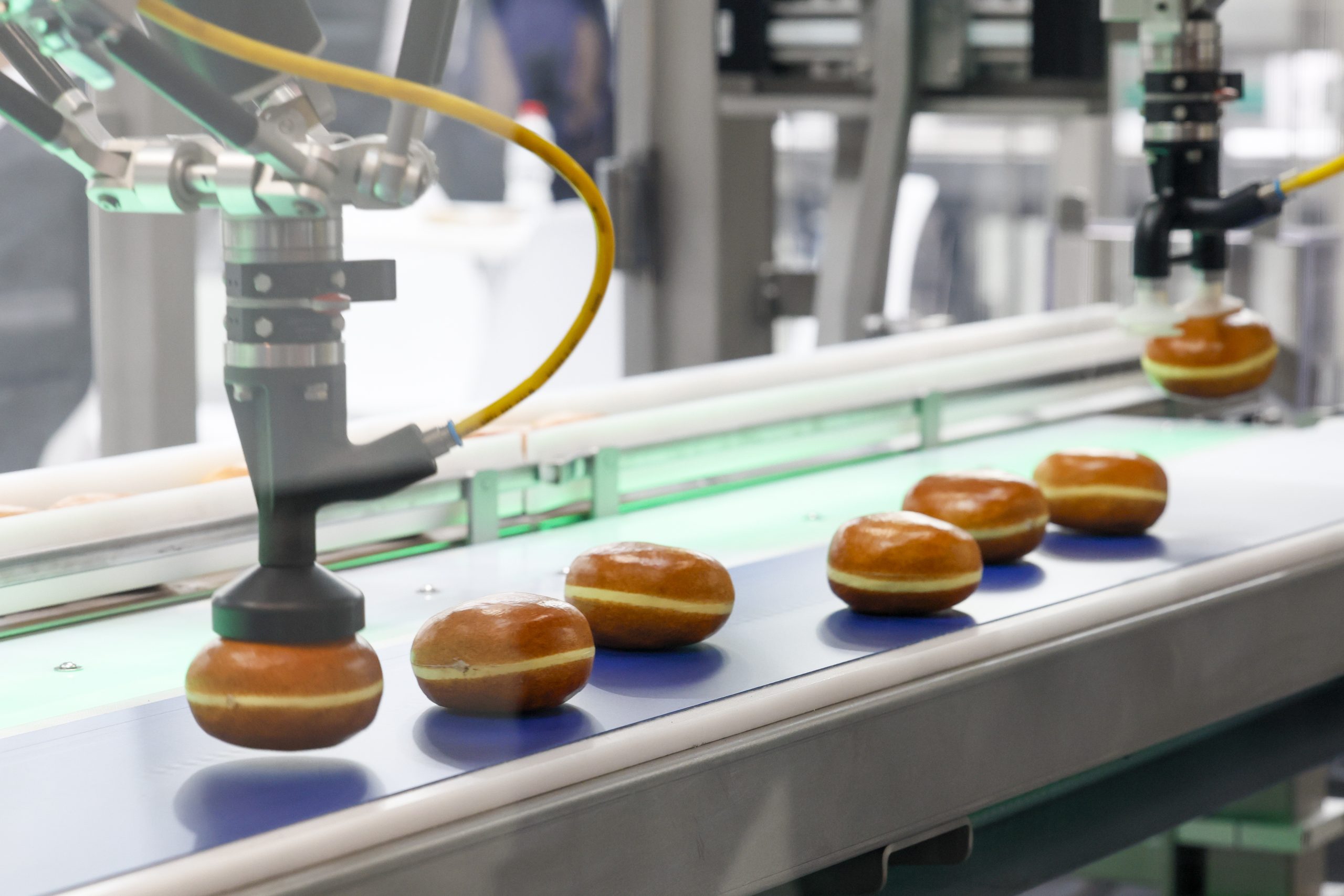
Top-loading is particularly well-suited to products with a degree of geometric variability or fragility, because it allows for the integration of flexible handling systems, such as delta robots, mechanical systems, and hybrid solutions, which can incorporate machine vision where the application requires it.
The main advantage of top-load is its ability to adapt to complex products or format changes while maintaining a high level of operational flexibility within the line.
→ See our case study on a confectionery bag case packing line.
Side-load case packer
In side-loading systems, products enter the pre-formed case from the side by means of linear pushers. This is a common solution for stackable, regular products of uniform format, such as biscuit boxes, flow-wrap packs, cosmetics, and small FMCG cartons. Side-loaders can achieve high production speeds by operating in a continuous cycle.
Here, the product arrives in a controlled, linear arrangement, normally with consistent spacing. In many cases, it is already grouped in the final packaging pattern. This system does not organize the products itself. Rather, it relies on a perfectly synchronized feed from earlier stages of the line.
The main advantages are high throughput on stable, high-speed lines combined with great mechanical robustness and simplicity of operation.
Wrap-around case packer
The wrap-around case packer is one of the most efficient solutions for high-output applications and fast-moving consumer goods (FMCG) environments. In this system, the case is formed from a flat corrugated blank that is folded and sealed around the product during the packing process itself, combining case forming and product collation in a single operation.
This concept requires a highly stable and perfectly synchronized product flow with products arriving prearranged in defined patterns. Precision in the feed is critical, since any variation in product position, pace or consistency directly affects the performance of the system.
The main advantage is the optimized use of packaging material. The case wraps almost exactly around the contour of the product, minimizing empty space and improving the overall logistical efficiency. In addition, the result is a highly rigid structure that provides stability during transport and palletizing.
This solution is particularly widespread in the food and beverage industry, as well as in FMCG applications with stable formats and high repeatability.
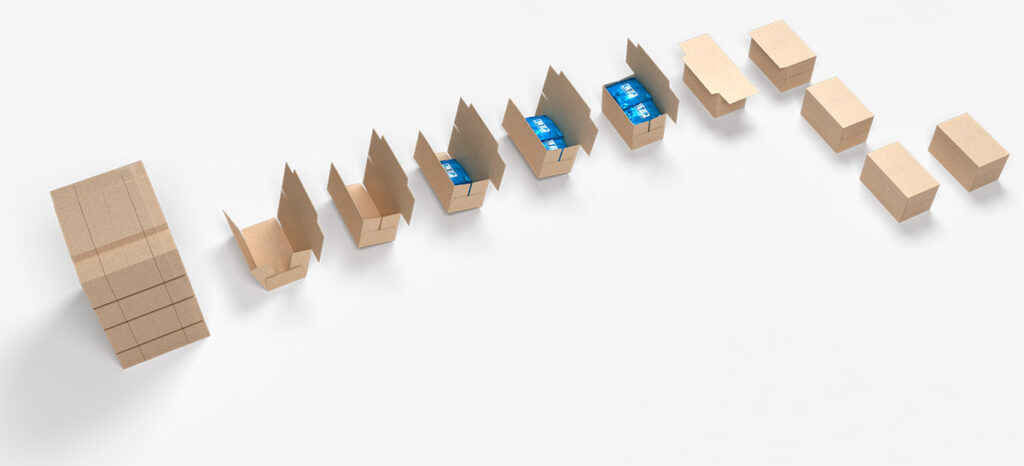
Display case packer
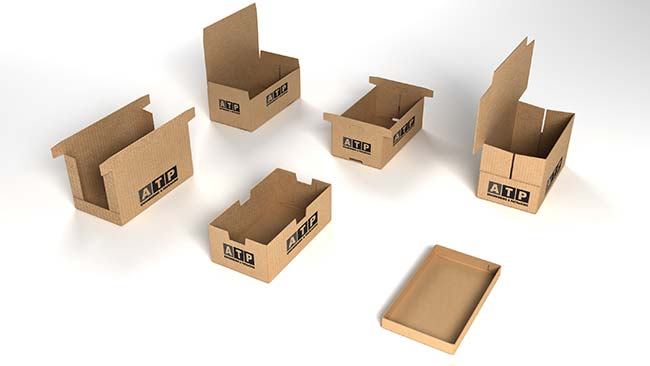
A display case packer is used in applications where products are placed directly into trays or die-cut cases designed for display at the point of sale. This type of secondary packaging is designed to go directly from the end of the production line to the retail shelf without any additional handling.
Depending on the type of product, the stability of the flow, and the line’s level of automation, the packing system may be implemented using top-load or side-load configurations, or even solutions with integrated case forming.
Products usually arrive pre-aligned or grouped in defined patterns since placement accuracy ensures the functionality of the packaging and the final presentation at the point of sale.
The main advantages are reduced downstream handling and improved efficiency in preparing products for retail, which optimizes both logistics and on-shelf product visibility.
Automatic vs semi-automatic case packers: key differences
In addition to the loading system, it is important to distinguish between the two main levels of automation:
Automatic case packer
An automatic case packer carries out every stage of the process autonomously, including case erection, product collation and loading, and closing and sealing. Plant staff supervise the operation but do not intervene. These machines are best suited for high production volumes with few format changes. They allow for the integration of traceability systems, coding, machine vision, and in-line quality control.
Our automatic case packers can handle both rigid and flexible products and form all kinds of cases, such as B1, Packmaster, trays, and display cases, from flat blanks and pre-formed cases.
Semi-automatic case packer
A semi-automatic case packer requires human intervention at some stage of the process, typically for manually erecting and placing the case in the machine. From that point on, the machine automatically fills and seals the case. This solution is suitable for medium production volumes, lines with frequent format changes, and companies looking to automate with a more modest initial investment.
Industrial applications: sectors that use case packers
Industrial case packers are versatile pieces of equipment, found in virtually any industry that requires secondary packaging to bring its products to market. Some of the sectors that have benefited most from advances in automated case packing include:
Food: One of the sectors with the highest demand for case packers, due to its production volumes and the variety of formats it handles. Case packers are used to collate and pack baked goods, frozen products, vacuum-packed items, snacks and fresh produce, among others.The most common requirements in this field are line speed and the ability to adapt to frequent product changeovers. Case packers in this sector are typically built to specific hygiene standards and feature easy-clean structures, materials suitable for frequent washdowns, and configurations that minimize areas where product or residue can accumulate.
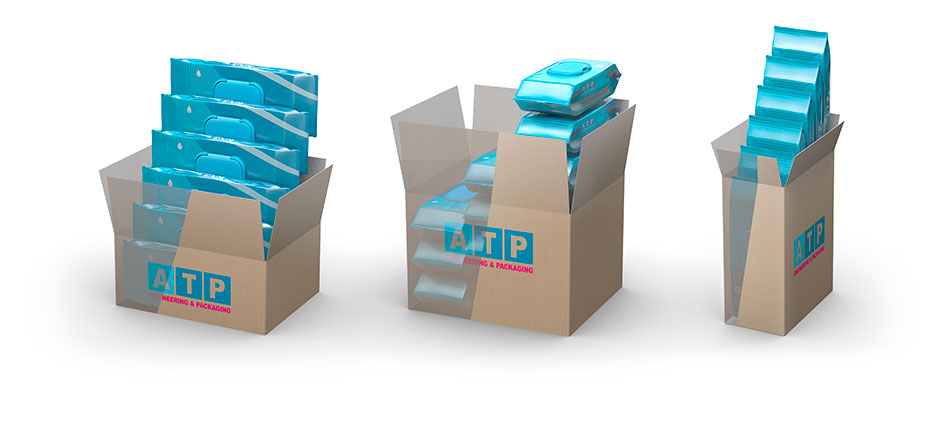
Hygiene: Products such as wet wipes and personal hygiene items have specific handling and collation requirements. Case packers in this sector must combine positioning accuracy with systems that can manage multiple pack formats on the same line.
Cosmetics: Cosmetic containers are often delicate and of variable geometry with finishes that cannot tolerate marks or excessive pressure. Robotic case packers with suction cups or adapted grippers are the usual solution as they can carefully handle creams, gels, promotional kits, and hair-removal products with quick format changeovers.
Household goods: The household products sector includes very different product lines, such as domestic cleaners, detergent capsules, multi-purpose wipes, and laundry products. Case packers used here must be versatile and robust with designs and materials that facilitate cleaning and maintenance on lines that handle chemical products.
Criteria for choosing a case packer
- Product type and characteristics: The weight, size, fragility, regularity of geometry, and rigidity or flexibility of the product directly determine the most suitable loading system.
- Production volume and speed: The required units per hour determine whether the solution should be semi-automatic or automatic, and which loading technology is most appropriate.
- Format flexibility: If the line handles many product lines or frequent format changes, systems with automatic adjustment or robotic solutions should be prioritized.
- Case type: Not all case packers work with every case format. Check compatibility with B1 cases, wrap-around cases, trays, display cases, and pre-formed cases.
- Available floor space: Some in-line systems require more installation space, while robotic solutions tend to be more compact and adaptable to different plant layouts.
- Level of integration required: If the case packer needs to communicate with traceability systems, automatic palletizing, ERP or SCADA, then the equipment’s connectivity is a decisive criterion.
- Maintenance and technical support: High-availability equipment requires a manufacturer with responsive technical assistance and readily available spare parts.
Advantages of automating case packing
Investing in an automatic case packer offers many tangible benefits:
- Greater speed and productivity: Continuous, precise operation maximizes the number of cases per hour, eliminating the limitations of manual packing.
- Fewer errors and rejects: Automation ensures consistent quality in every cycle with the same product arrangement and seal on each case.
- Lower operating costs: Reliance on direct labor for repetitive, physically demanding tasks is reduced, freeing staff for higher-value work.
- Better traceability: Integration with coding systems, machine vision, and data management enables precise recording of the contents, batch, and date of every case.
- Greater consistency for palletizing: Uniform, well-sealed packaging improves case stability on the palletizer and optimizes logistics space.
- Improved ergonomics and safety: Eliminating repetitive manual loading, which reduces staff fatigue and the risk of injury.
In short, the case packer is a central element of any modern industrial production line. The choice of loading type – top-load, side-load, wrap-around, or robotic – depends on the product’s characteristics, production volume, and the manufacturer’s specific needs. Today’s technology, with integrated machine vision and robotics, delivers levels of efficiency, flexibility, and traceability that were previously unattainable for most companies.
If you are considering adding a case packing machine to your production line, the first step is to analyze your production requirements in detail. At ATP Packaging, we support our clients from design to commissioning, providing solutions tailored to their sector and objectives.
Frequently asked questions about case packers
Can a case packer work with different case formats?
Yes. Today’s multi-format case packers allow for product changeovers through parameter adjustments on the HMI screen. The most advanced models feature automatic, servo-driven adjustments. Our case packers can handle B1, Packmaster, tray, and wrap-around cases, among others.
How much space does an industrial case packer take up?
It depends on the model and the line architecture. High-output wrap-around case packers usually require more space, as they integrate case forming, collation and closing in a continuous flow, together with the associated feeding systems. Robotic solutions, on the other hand, can offer a more compact footprint in the packing area. However, their final integration depends on the conveying system, buffers, and safety requirements. In all cases, planning the line layout before selecting machinery is essential.
Can a case packer be integrated into an existing production line? Yes, in most cases. Modern case packers are integrated via conveyors, PLCs and standard communication protocols. At ATP Packaging we provide technical advice from the project design stage to ensure correct integration without interrupting production.
What is the difference between a case packer and a cartoning machine? Although the terms are sometimes used interchangeably, a cartoning machine generally works with folding cardboard cartons, typically for primary packaging or for retail-ready presentations and light grouping of products. By contrast, a case packer handles secondary packaging, such as shipping cases, trays, and corrugated cardboard solutions designed to protect and support the logistical distribution of the product.
Both systems can coexist within the same production line, particularly in processes that combine cartoning with grouping products for transport.