In any food packaging line, picking is one of the most critical and demanding operations. High production speeds, delicate products, strict hygiene requirements and the need to handle multiple formats often mean that manual picking becomes the bottleneck of the entire line.
According to data from the Spanish Association of Robotics and Automation (AER Automation), the food industry ranks third in terms of industrial robot installations in Spain, behind only the automotive and metal sectors. This reflects the extent to which automation has evolved from an option to a necessity for remaining competitive.
While automating this phase is not a new trend, it is experiencing significant acceleration. Technologically mature automated robotic picking systems are more accessible and, above all, more flexible: they are no longer limited to high volumes of a single product. Today, it is possible to automate picking on lines with a wide variety of SKUs, frequent format changes and demanding quality and hygiene requirements.
However, with such a wide range of automation solutions available in the sector, questions often arise. What are the main types of picking robot available? What criteria should be considered when choosing the most suitable system? And how can this technology be correctly integrated into a food packaging line? Let’s address some of the most common ones.
What is an automated picking system?
It is a set of components, including robots, machine vision, control software, conveyors and peripherals, that enables products to be handled from a production line and placed in a container, tray, case or box in an orderly manner, without direct manual intervention.
In the context of food packaging, these systems can perform various tasks, such as:
- Feeding flowpack machines, thermoformers, or secondary packaging lines with bare products, individually packaged items, or multipacks.
- Loading trays, blisters, cases or boxes with products in the required pattern and orientation.
- High-speed pick-and-place of products with random arrival, such as pastries, biscuits, chocolates, pre-cooked foods, breaded items and similar products. Products with irregular shapes, variable sizes and delicate textures.
The key point is that it’s not just about the robot: the system as a whole is what matters. Machine vision, the HMI, the gripping tools, and integration with the rest of the line are just as critical as the robotic arm itself.
Types of picking robots
Delta Robot (or Spider Robot)
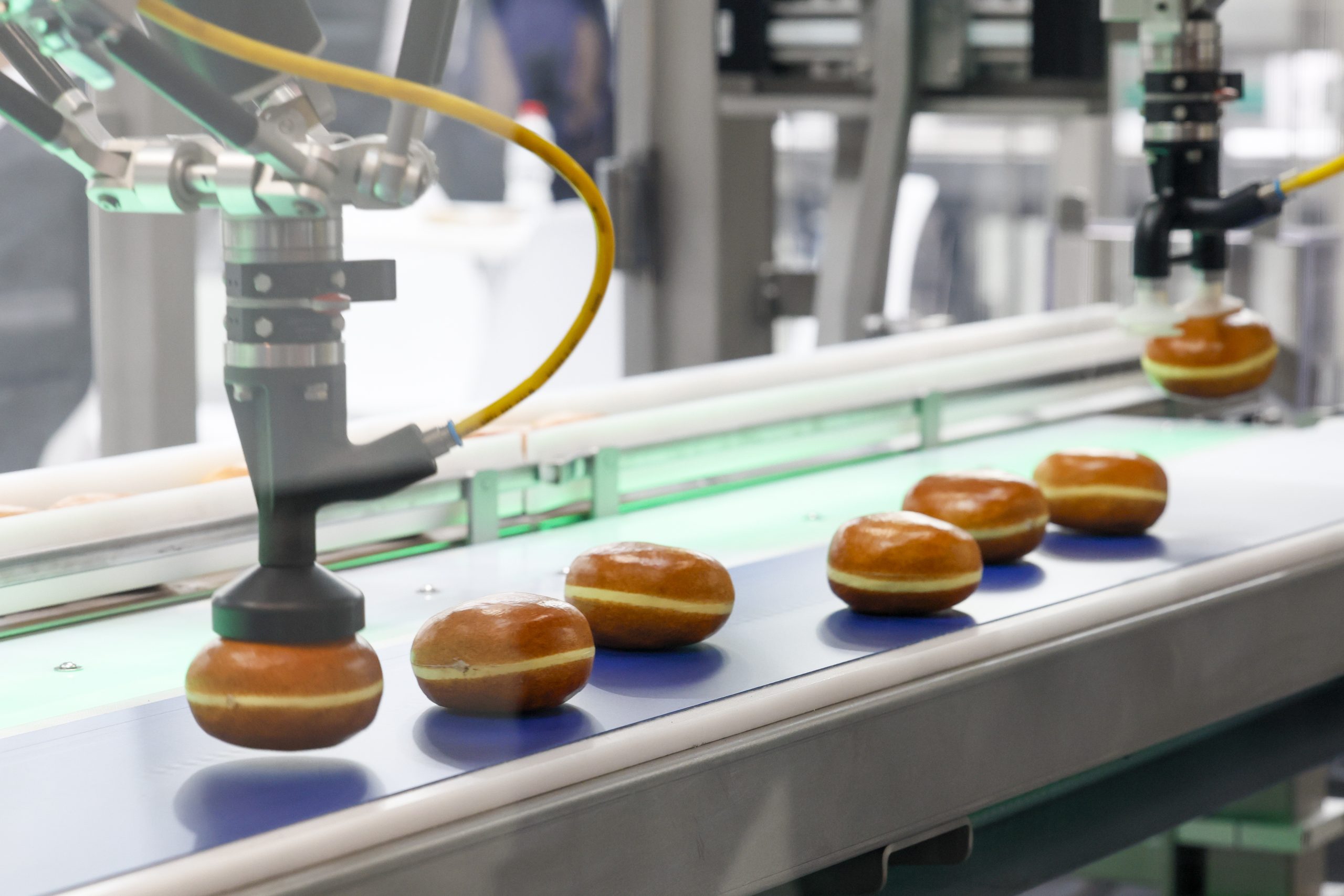
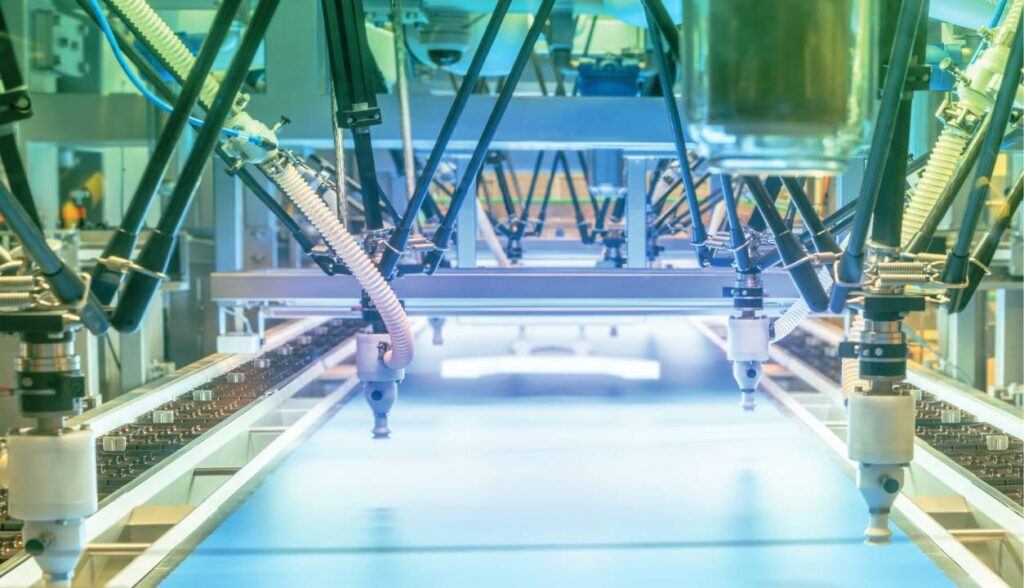
This is the most common type of robot used for high-speed picking in the food industry. Its articulated, parallel-arm structure enables it to achieve high speeds and accelerations with great precision.
Its main advantages are its speed (it can exceed 100 products per minute in some applications), precision and its open design, which makes cleaning easier. It is ideal for packaging products such as biscuits, croissants, napolitanas and cupcakes, and for loading trays with chocolates and similar products.
It typically operates using 2D or 3D machine vision to detect products moving along a conveyor belt, calculate their position and orientation, and perform the picking operation. This is essential when the product arrives randomly or with variations in position.
SCARA Robot
The SCARA (Selective Compliance Articulated Robot Arm) robot has four axes and primarily operates in a horizontal plane with an additional vertical axis. Its compact design and high speed make it ideal for medium-to-high-speed pick-and-place applications in confined spaces. It is used for packaging small products, loading cases, and on production lines where positioning accuracy is paramount.
6-Axis Articulated Robot
The conventional 6-axis articulated robot offers a wide range of motion and great flexibility in end effector orientation. While not the fastest for high-throughput pick-and-place applications, it allows for complex positions and orientations inaccessible to other types of robots. In picking applications, it is used when the task involves complex trajectories, varying heights or the handling of containers with special requirements. It is also commonly used in palletizing, where it is integrated at the end of the production line.
There are collaborative versions (cobots) of this type of robot, designed to work in spaces shared with people.
An important note about the food industry: not all industrial robots are suitable for working in contact with or in close proximity to food. The EHEDG (European Hygienic Engineering & Design Group) stipulates that robots used in food production, where microbiological contamination must be avoided, must meet specific hygienic design standards that go beyond the requirements for conventional industrial machinery. This criterion should be verified at the time of equipment selection, not afterwards.
The Role of Machine Vision in Robotic Picking
The integration of robotics and artificial intelligence now enables the handling of a wide variety of products, allowing for the picking of items of different types and sizes. This improves efficiency, reduces cycle times and contributes to the sustainability of the process.
The vision system enables the robot to ‘see’ where the product is, its orientation, and whether it meets the quality requirements for picking. Depending on the application, different technologies are used:
- 2D camera: The most common option for flat products or those with little variation in height. It enables the position on the plane and orientation to be detected with high processing speed.
- 3D camera: This is widely used when the product has height variations or in bulk picking applications. It provides depth information and calculates the position in three dimensions.
- Multi-camera systems: These are used when the line is wide, the speed is high or greater coverage is required. They combine several calibrated cameras to expand the field of view.
Machine vision also serves a quality control function as it can detect misaligned, defective or non-compliant products and remove them from the process without stopping the line.
Key criteria for choosing the right picking system:
There is no one-size-fits-all picking solution. The choice depends on a combination of technical and operational factors that must be analyzed in detail before making a decision.
1. Required production speed
This is the first parameter to be evaluated. How many products does the system need to handle per minute? This determines the type of robot and the number of units required. On many production lines, a single robot is not sufficient; multiple units are instead used in parallel with tasks distributed among them to achieve the required throughput.
2. Product characteristics
The size, weight, fragility, geometry, texture, and product arrival directly influence the design of the gripping system and the selection of the robot. For example, a croissant would be handled differently to a chocolate bonbon or a bag of snacks. Gripping systems (e.g. suction cups, mechanical grippers or other specific end effectors) are designed according to the product and incorporate solutions that facilitate cleaning and compliance with hygiene standards.
3. Product variety and format changes
If the line handles a single product, optimization is simpler. However, if there are frequent changes in product type or collation/grouping, the system must adapt quickly. In this context, control software plays a key role: a well-designed human-machine interface (HMI) allows for intuitive management of format changes. It is also important that mechanical format changes are quick and require minimal or no tools.
4. Product destination: what comes after picking?
The next stage of the process, flow-pack, carton or box, determines how the product must be placed (position, orientation and grouping pattern), and therefore the movements the robot must perform.
5. Hygiene requirements and ease of cleaning
In the food industry, hygiene standards are non-negotiable. According to EHEDG Guideline 29 on the hygienic design of packaging machinery, these criteria must be applied from the machine selection phase and not just during development. In practice, this means evaluating aspects such as accessibility for cleaning, the absence of dead zones where product can accumulate, and materials in contact with food.
6. Integration with the rest of the line
The picking cell does not operate in isolation. It must be properly coordinated with the preceding elements, such as production output, accumulation systems, and FIFO/LIFO buffers, as well as the subsequent elements, such as packaging machines, cartoning machines, and case packers. Critical aspects for the line to operate smoothly and efficiently include communication between machines, downtime management, and speed synchronization.
Lines with task sharing between robots
One of the most advanced and efficient automated picking configurations is a line with multiple robots that share the workload in a synchronized manner. Rather than operating independently, the control system dynamically distributes picks among the units based on their availability, the product’s position, and the line’s speed.
Common mistakes when implementing a robotic picking system:
- Underestimating product variability. In real-world production, products never arrive exactly alike. Variations in size, weight, frequency, position, and surface are inevitable. The system must be designed to handle these variations.
- Failing to plan for format changes from the outset. If the line is going to handle multiple products or formats, this must be defined during the design phase, not as a later adaptation. Incorporating flexibility after the fact usually entails greater technical complexity and higher costs.
- Underestimating cleaning requirements is another common mistake. A system that is difficult to clean will eventually lead to hygiene issues, unplanned downtime, and friction with the production team. Hygienic design must be a selection criterion from the start of the project.
- Failing to consider maintenance is another common mistake. Access to key components, the availability of spare parts, and the ability to perform diagnostics and provide remote assistance affect the operating costs of a line over its lifespan.
Conclusion: Selecting automation as a competitive advantage.
Automating the picking process on a food packaging line is not just a matter of speed. This decision impacts product quality, hygiene standards, process flexibility, and a company’s ability to adapt to changes in demand and become more competitive.
Today’s technology can accommodate a wide range of applications, from high-speed lines that handle a single product to multi-format lines with frequent product changes.
The key is to conduct a comprehensive analysis of requirements before selecting a system and to partner with a technology provider that has real-world experience with these solutions in industrial food environments.
At ATP Packaging, we have over 25 years of experience designing and implementing robotic picking lines for the food industry. If you are considering automating this phase of your process, we would be delighted to analyze your application with you.